

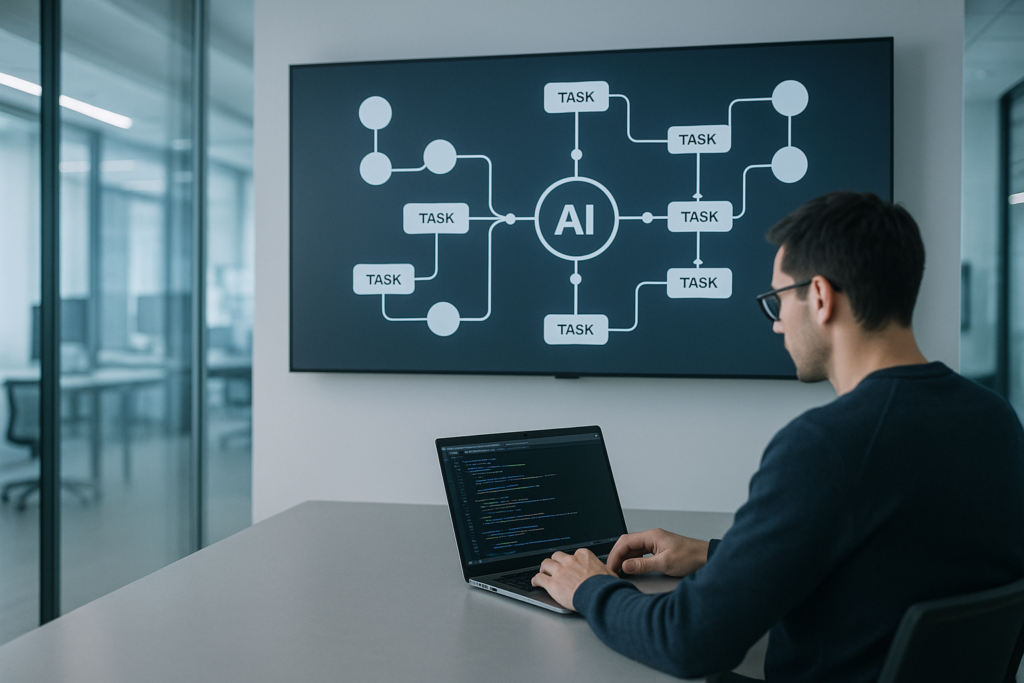
L’engouement pour les agents IA en entreprise est réel. Pourtant, entre l’expérimentation et le déploiement industriel, un fossé énorme persiste. Voici pourquoi ça coince, et ce que les équipes techniques doivent anticiper dès maintenant.
Les agents IA en entreprise : une réalité de laboratoire en 2026
Selon les données remontées mi-2026, 62 % des entreprises expérimentent des agents IA. C’est un signal fort. Mais seulement 23 % les ont déployés à l’échelle dans au moins une fonction métier. Moins de 10 % les ont étendus à plusieurs fonctions.
La conclusion est claire: l’adoption est large, la maturité opérationnelle ne suit pas. On est encore en phase de POC glorifié, pas de production réelle.
Un agent IA ne se contente pas de répondre à une
Un agent IA ne se contente pas de répondre à une question. Il perçoit un contexte, décide d’une séquence d’actions et les exécute via des outils externes: APIs, bases de données, logiciels métiers.
cette capacité à agir de façon autonome qui change la revue de code. Et c’est aussi ce qui rend la mise en production beaucoup plus complexe qu’un simple chatbot RAG.
La facture surprise : 10 à 20 fois plus cher qu'un chatbot classique
Le Journal du Net a mis le doigt sur un problème structurel que beaucoup de DSI découvrent trop tard. Un agent autonome effectue entre 10 et 20 appels au modèle là où un chatbot standard en fait un seul.
Ce n’est pas un bug de configuration. C’est inhérent au fonctionnement agentique: planification, raisonnement, appels d’outils, vérification des résultats. Chaque étape coûte.
Avant tout passage à l’échelle, un chiffrage réaliste des coûts computationnels est indispensable. Ce n’est pas optionnel, c’est un prérequis de gouvernance.
Sécurité agentique : le parent pauvre des discussions
Les risques liés aux agents autonomes restent largement sous-médiatisés. Un chercheur en master à Aix-Marseille le souligne directement: les incidents potentiels liés aux agents agissant sur des données d’entreprise reçoivent beaucoup moins d’attention que les accidents de véhicules autonomes. Pourtant, l’impact opérationnel peut être aussi sévère.
Trois surfaces d’attaque concentrent les risques:
- Gestion des identifiants: comment un agent accède aux systèmes tiers sans exposer les credentials des utilisateurs ou des clients ? Un fil Reddit sur n8n illustre concrètement cette difficulté: comment déployer un agent IA pour un client sans jamais avoir accès à ses mots de passe ?
- Transactions autonomes: le partenariat Visa/OpenAI autour d’un protocole « Trusted Agent » tente de répondre à cette question pour les paiements. La confiance accordée à ces tiers techniques reste un sujet ouvert.
- Actions irréversibles: un agent qui exécute des actions en cascade sur des systèmes métiers peut provoquer des dommages difficiles à corriger si une étape échoue ou est détournée.
Traiter la sécurité agentique comme un prérequis, pas comme une feature à ajouter plus tard, c’est la posture que j’attends d’une équipe sérieuse.
Le cas Polsia : modèle sans employés et questions de crédibilité
La startup Polsia a levé 30 millions de dollars en fonctionnant sans employés humains, entièrement pilotée par des agents IA. Le cas est discuté avec un scepticisme notable dans les communautés francophones.
Le modèle est spectaculaire sur le papier. Mais les réactions pointent les vraies questions: qui est responsable en cas d’erreur ? Comment auditer les décisions d’un système entièrement autonome ? Ces questions ne sont pas rhétoriques, elles touchent directement à la conformité et à la responsabilité légale.
Ce que les intégrateurs vivent au quotidien
Au-delà des annonces, les difficultés terrain sont bien documentées par les communautés de développeurs. La gestion des credentials clients dans des workflows n8n, l’orchestration des appels d’outils, la gestion des erreurs dans des chaînes d’actions longues: ce sont ces problèmes concrets qui ralentissent les projets.
Les frameworks agentiques progressent vite. Mais la distance entre un prototype qui fonctionne en démo et un agent fiable en production reste significative.
Si vous ne retenez qu’une chose : La vraie rupture n'est pas technologique. Elle est économique, organisationnelle et sécuritaire.
Sources
https://www.journaldunet.com/intelligence-artificielle/1551391-agents-ia-en-entreprise-la-facture-qui-surprend-les-modeles-qui-disparaissent-et-ce-que-les-dsi-font-maintenant/
https://alexitauzin.com/agents-ia-en-enterprise-adoption-massive-roi-rare-le-paradoxe-de-2026/
https://www.master-ia.fr/agents-ia-entreprise
https://www.reddit.com/r/actutech/comments/1u6q58a/visa_gère_les_transactions_générées_par_ia_pour/
https://www.reddit.com/r/artificielle/comments/1u5odeq/la_startup_ia_sans_employés_polsia_littéralement/
https://www.reddit.com/r/n8n/comments/1tu708r/quel_est_le_meilleur_moyen_de_connecter_le_compte/