


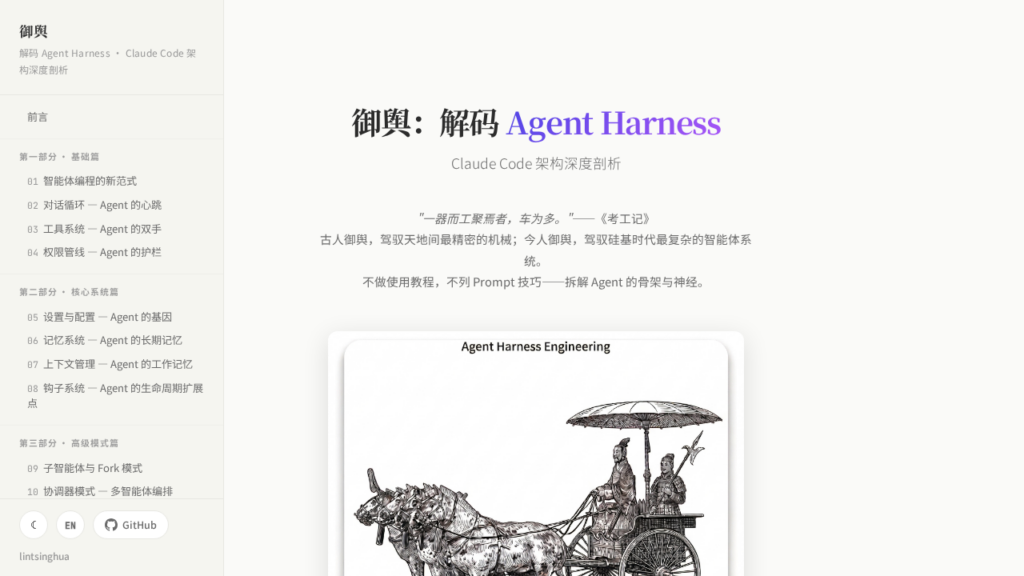
claude-code-book is an online book, not a CLI tool, that breaks down Claude Code’s architecture and the Agent Harness concept. Yes, it’s worth it if you’re building or auditing autonomous agents, but you need to accept a very dense format, closer to an architecture manual than a copy-paste tutorial.
What is claude-code-book?
The lintsinghua/claude-code-book repository publishes 《御舆:解码 Agent Harness》, a Chinese-language book with an English version in the same repo. The subject is clear: understanding how a production-grade code agent holds together, covering the dialogue loop, tools, permissions, memory, hooks, sub-agents, MCP, skills, and streaming.
This is not a library you install in a project. It’s a documentation resource structured into 15 chapters and 4 appendices. The README advertises 42万字, roughly 420,000 Chinese characters, and cloning the repo confirms one thing above all: the repository is made of Markdown, not an application package.
| Point tested | Observed result |
|---|---|
| Cloned repo | 44 versioned files |
| Markdown | 42 files |
| Versions | Chinese and English |
| Mermaid diagrams | 157 blocks per language in my count |
| Local build provided | No package, no build script |
| Live site | Functional GitHub Pages |
Installing claude-code-book
I started the way any proper GitHub scout would: fresh clone into /tmp, README read-through, dependency search, then launching the reading site with headless Chromium to check the actual render.
git clone --depth 1 https://github.com/lintsinghua/claude-code-book /tmp/claude-code-book
cd /tmp/claude-code-book
git ls-files | wc -l
git ls-files '*.md' | wc -l
git ls-files | grep -Ei 'package.json|vite|mkdocs|docusaurus|requirements|pyproject|Makefile|Dockerfile'
Important result: the last command returns nothing. There’s no package.json, no mkdocs.yml, no docusaurus.config, no Dockerfile, no Makefile. So the actual “installation” of this product, on the repo side, comes down to cloning and reading Markdown files.
To test the published experience, I opened the official site listed in the README: https://lintsinghua.github.io/. There, you do get a proper web interface: sidebar, clickable chapters, clean typography, internal navigation. That said, the code behind that interface isn’t shipped as a reproducible project in the repo I cloned.
Using claude-code-book in practice
My concrete use case: looking for actionable ideas to build or audit an Agent Harness, specifically the dialogue loop, the permission pipeline, and the step-by-step process for building your own harness.
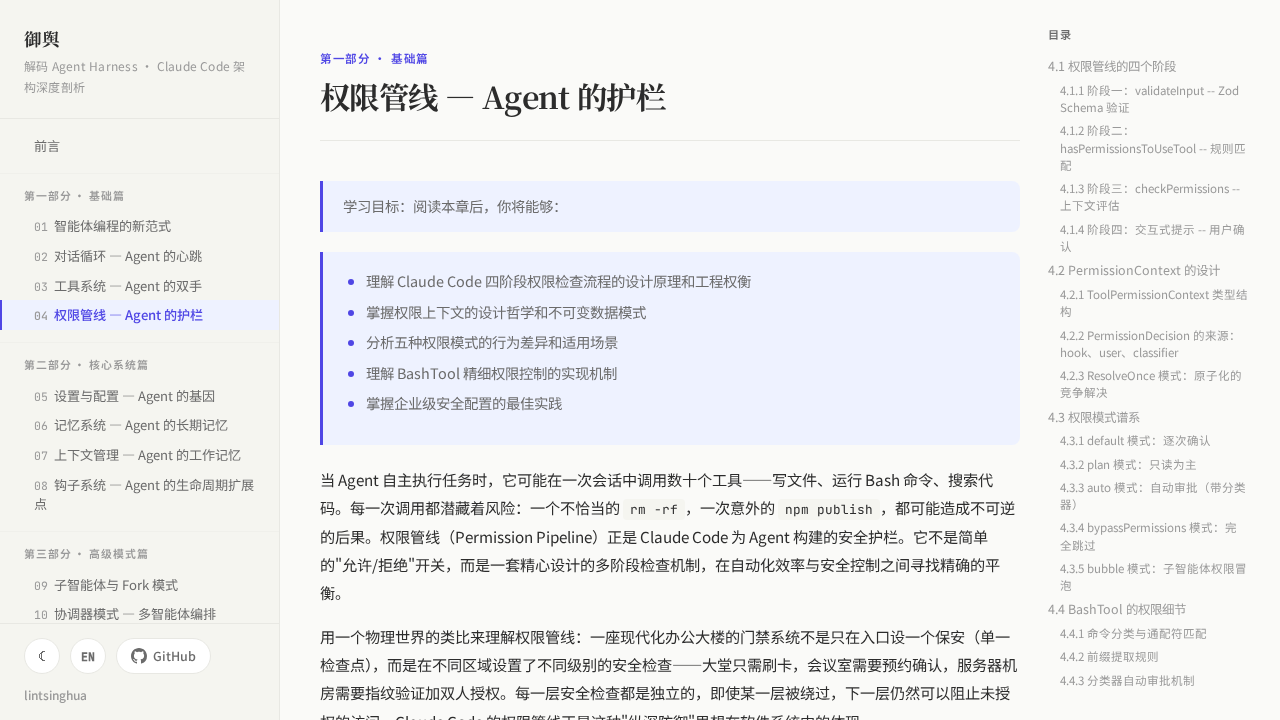
I started with chapter 15 from the web interface. This chapter doesn’t just say “make an agent.” It breaks the build down into steps: dialogue loop, tool system, permissions, context management, memory, hooks. That’s exactly the kind of framework that helps when you’re moving from an LLM prototype to an agent that needs to write files, run commands, and keep track of its own decisions.
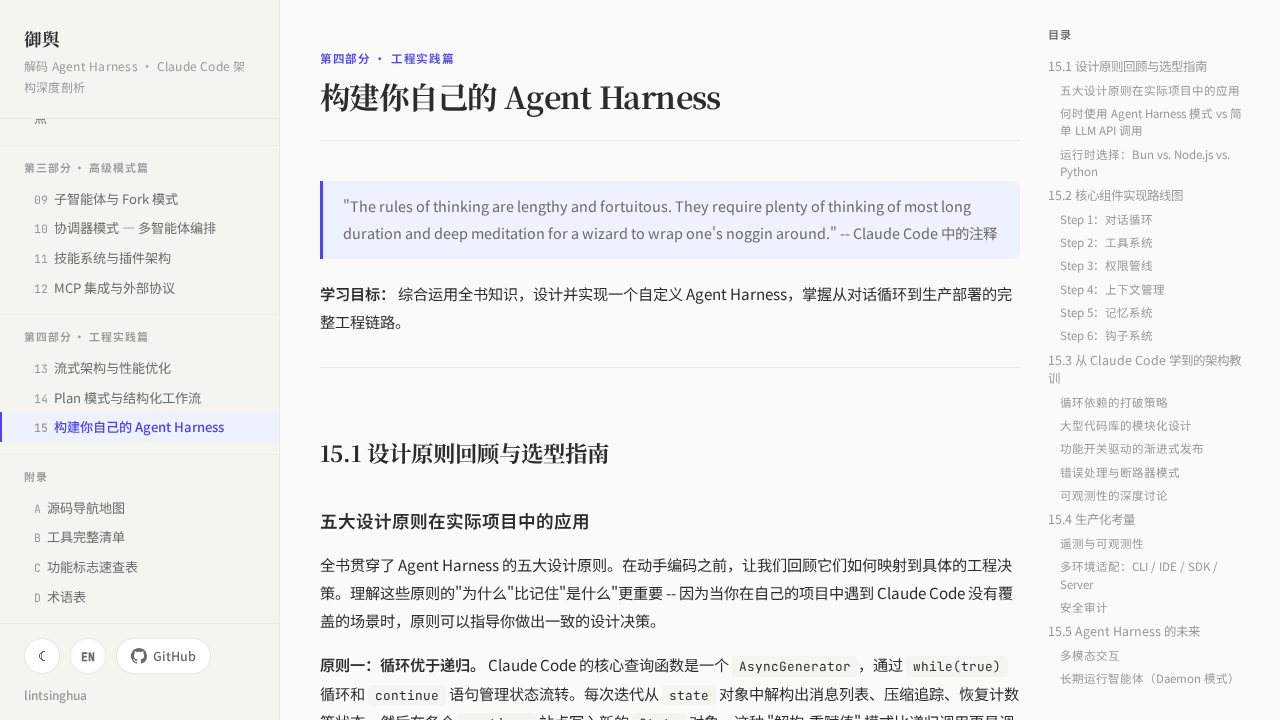
Next, I tested chapter 04, the one on the permission pipeline. For a security or DevOps profile, this is the most immediately useful chapter. It describes a multi-step model: input validation, authorization rules, context evaluation, user confirmation. You also find the various permission modes, including plan mode, auto mode, and finer-grained rules around shell commands.
What the product “produces” in this test isn’t a binary, a JSON report, or a local server. It produces a navigable knowledge base rich enough to guide a design. I was able to start from a practical question, “how do I constrain dangerous actions in an agent?”, and find a structured answer with vocabulary, mental models, and key considerations.
What I like about claude-code-book
First good point: the book talks about architecture, not just prompts. Most agentic resources stay at the “call this model with this tool” level. Here, the core subject is the harness around the model: state, permissions, context compression, orchestration, errors, and observability.
Second good point: the structure is usable. The appendices act as a map, each chapter has clear objectives, and sensitive topics aren’t glossed over. The permission pipeline, hooks, MCP, and sub-agents are treated as subsystems, not as gimmicks.
Third good point: both Chinese and English versions are in the repo. Even if the book feels primarily written in Chinese, having an English version makes it easier to share across an international team.
Finally, the live site is pleasant to read. The left-hand navigation makes the 15 chapters feel less overwhelming, and the rendering of technical content is clean in Chromium.
The limits of claude-code-book
The main limitation is straightforward: this is not an executable product. If you’re looking for an Agent Harness library, a CLI, or a ready-to-run Bun template, you won’t find it here. Chapter 15 gives you a roadmap, but not an installable skeleton.
Second limitation: site reproducibility from the repo is incomplete. The README points to a polished GitHub Pages interface, but the cloned repo doesn’t include the web project that would let you rebuild it locally. For a reader, that’s not a blocker. For a maintainer or auditor, it’s frustrating.
Third limitation: the book is ambitious and dense. For a junior developer or someone who just wants to use Claude Code day-to-day, the level of abstraction can be too high. You need prior hands-on experience with agents, tools, streaming, or permissions to get the most out of it.
Does claude-code-book actually work?
Yes, if you judge the product for what it is: an online technical book. The site loads, chapters render, navigation works, and the content answers real questions about agentic architecture.
No, if you’re expecting an installable tool. There’s nothing to run locally beyond reading the Markdown files. I would have appreciated a site folder, a build script, or at least a clear explanation of the GitHub Pages pipeline.
My verdict: worth trying for architects, freelance DevOps engineers, platform teams, and developers designing agents with risky actions. Skip it if you’re looking for an out-of-the-box framework.
Should you adopt claude-code-book?
I’d put it in the “keep on hand” category, not “install in every project.” For an agent audit, it provides a mental checklist: where’s the loop, who authorizes the tools, how is context compacted, how do hooks modify the lifecycle, how do sub-agents inherit or isolate state.
For freelance security and DevOps work, it’s useful as a design reference. I’d come back to it before signing off on an agent that can touch the shell, cloud infrastructure, Git repos, or secrets.
Clear verdict: try it, especially to learn how to think through an Agent Harness. Don’t sell it as a deployable solution.
FAQ
Is claude-code-book an agent framework?
No. It’s a book and knowledge base on agent architecture, not a library you import.
Can you use it without knowing Chinese?
Yes. The repo includes a complete English version, even though the main site and original tone are Chinese.
Is it useful for a DevOps or security profile?
Yes, especially the chapters on permissions, tools, hooks, MCP, and production. Those are the areas where an autonomous agent becomes powerful, but also dangerous if it’s not properly constrained.