


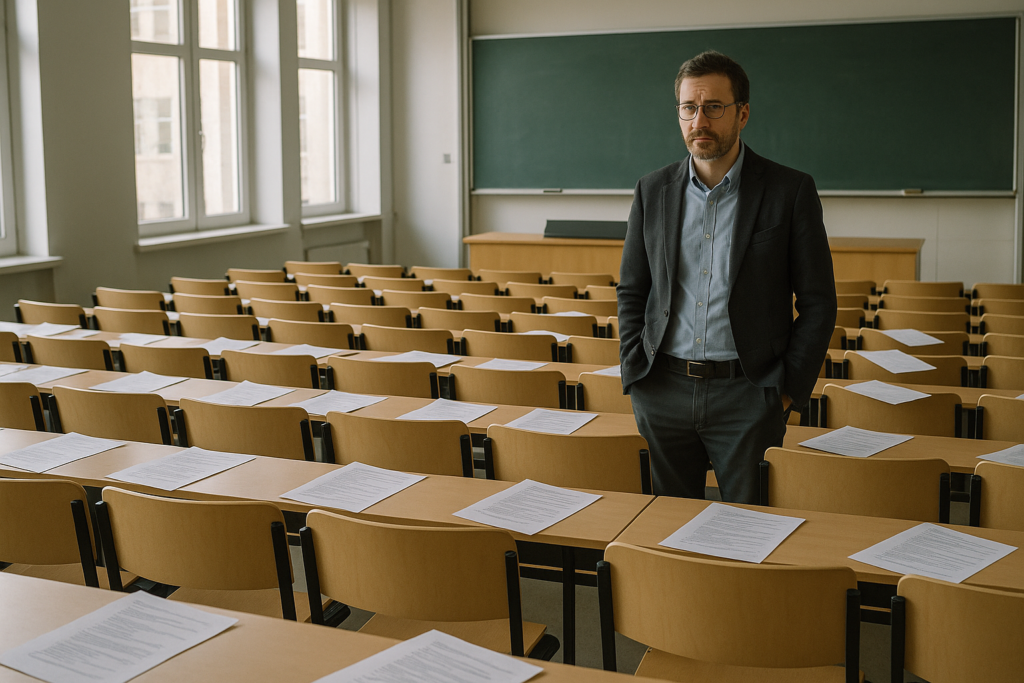
AI fraud in universities is no longer an isolated incident. At Brown University, one of the most prestigious Ivy League institutions, a documented and large-scale case has just forced a professor to step outside the usual disciplinary channels and go public.
The AI Fraud at Brown University: What Happened
Professor Roberto Serrano has been teaching advanced mathematical economics at Brown for 34 years. This semester, due to the post-traumatic atmosphere on campus following a shooting in December 2025, he offered a take-home midterm in open-ended question format.
The result: a class average of 96 out of 100. Forty students out of 89 scored a perfect 100.
Graders quickly noticed unusual passages consistent with ChatGPT-generated responses. Serrano then announced that the final exam would be in person. The average dropped to 48 out of 100. Of the 27 students who skipped the final, 22 had scored a perfect 100 on the midterm.
“The empirical evidence of fraud is overwhelming,” he said. El País reports this may be the largest known academic scandal in Ivy League history.
A Warning Sign the Institution Ignored
Serrano reported the case to Brown’s administration. The response was ice cold. The president didn’t reply. Neither did the dean, until the matter was brought before the academic code committee. Brown then acknowledged a “warning sign” and left it at that.
This institutional timidity is no coincidence. Serrano himself points to an uncomfortable reality: elite universities depend on donations from very wealthy families, whose children often study at these same schools. “Students always get the benefit of the doubt. I’ve seen it on other occasions,” he admits.
Faced with that silence, he chose to go public. Not to punish, but to force a real debate.
Why This Case Goes Beyond Brown
AI fraud in higher education is not a local phenomenon. Several signals are converging.
- Princeton has ended 133 years of tradition: professors will now supervise exams in person, a practice that had been abandoned since 1893.
- Journalist Theo Baker, a Stanford graduate, wrote in the New York Times: “I don’t know a single person who hasn’t used AI to finish an assignment in college.”
- Cases of cheating via AI-connected glasses have been reported at universities in Asia, including Hong Kong.
The tools are changing. So is behavior. Assessment structures, however, haven’t caught up yet.
What Serrano Is Changing Concretely
The professor has already drawn his conclusions for the coming academic year. His adjustments are straightforward.
- Weekly exercises will no longer count toward the final grade, since they can easily be outsourced to AI.
- Take-home exams are done, regardless of the reason given.
- In-person exams become the standard again.
These choices don’t solve the structural problem. But they show that a teacher can adapt their assessment approach without waiting for an institutional response.
The Real Debate: What Is a Degree Even Worth Anymore?
Behind the fraud lies a broader question that Serrano raises explicitly. If advanced students in a mathematical economics course prefer to copy rather than learn, something has shifted in how people relate to knowledge.
A degree is increasingly seen as an end in itself, a ticket into the job market rather than evidence of real training. Generative AI didn’t create that tension. It simply made it visible and exploitable at scale.
“If we no longer defend truth, decency, and honesty, what credibility will we have as academics?” Serrano asks in the El País article.
That question goes far beyond Brown, and it speaks to every higher education institution out there.
Key Takeaways
- At least 50 students used AI to cheat on a midterm at Brown University, based on evidence gathered by Professor Serrano.
- The institution responded with indifference, forcing the professor to go public to open a broader debate.
- The sharp drop in results between the take-home and in-person exams is solid, well-documented empirical evidence.
- Princeton and other elite universities are already starting to adapt their assessment methods in response to AI pressure.
- The real issue isn’t technical: it’s the perceived value of a degree and the integrity of the education behind it.
If this topic resonates with you, particularly the implications of AI for trust and verification in critical contexts, feel free to follow the blog or reach out directly. The question of detection and authentication in environments where AI is everywhere is at the heart of several topics covered here.