


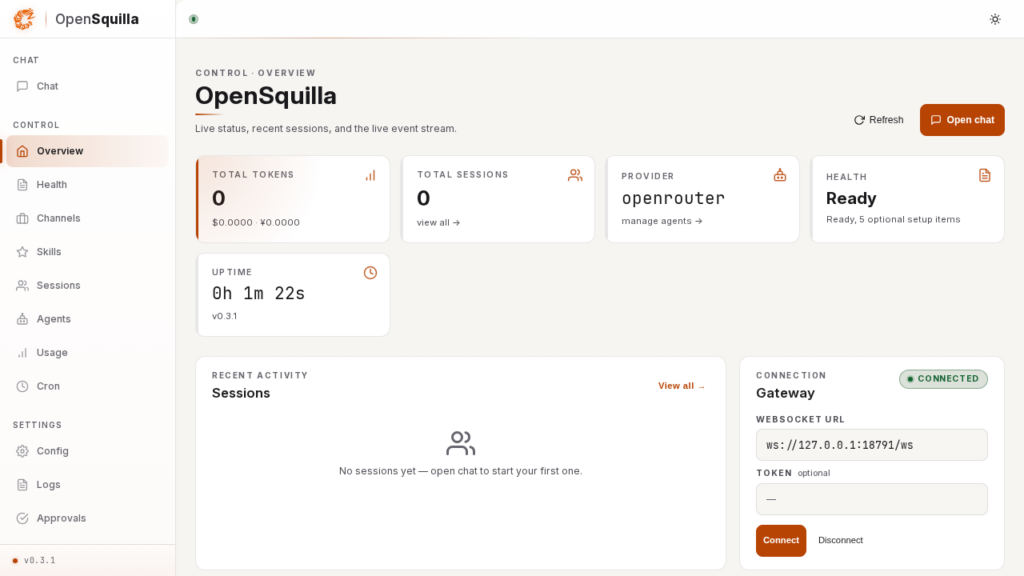
OpenSquilla is a local AI agent that promises to run CLI, web interface, memory, tools, and model routing in a single loop. My short verdict: it works for launching a real agent with an OpenAI-compatible provider, but the product is still young and you have to be comfortable getting your hands dirty with configuration.
I tested it the way I would test any tool I might integrate into a DevOps pipeline: clone the repo, install, configure via a local LLM proxy, run it against a small Python repo, then capture the web interface.
What is OpenSquilla?
OpenSquilla presents itself as a “microkernel” AI agent runtime. In plain terms, it tries to separate the LLM brain, tools, memory, chat channels, web interface, and permission policies, while keeping everything as a unified experience.
The repo advertises three main use cases:
- a command-line agent for one-off tasks,
- a local Web UI to control the agent,
- connectors and advanced features like memory, crons, web search, sessions, and a gateway.
The “token-efficient” positioning mostly comes from SquillaRouter, a local router designed to route requests to the cheapest model capable of answering. In my test, I did not validate this full router, because installing the recommended profile failed inside the container due to insufficient temporary disk space when extracting NumPy. So I tested the agent core, without the heavy recommended profile.
| Element | Observation during the test |
|---|---|
| Repo version | 0.3.1 from the cloned branch |
| Main language | Python 3.12 required |
| Interface | CLI plus local Web UI |
| Provider tested | OpenRouter via local OpenAI-compatible proxy |
| Model used | openai/gpt-4o-mini |
| Test case | Security review of a small Python project |
Installing OpenSquilla
I cloned the repo into /tmp, as expected for a clean test, then read through the README, the quickstart, and the pyproject.toml. The project requires Python 3.12 and recommends uv.
The documented command for the recommended profile also pulls in heavy dependencies, including ONNX Runtime, LightGBM, scikit-learn, tokenizers, and NumPy. In my container, that path hit a clear error: no space left during NumPy extraction into /tmp.
So I switched to a source install of the base package, inside a temporary isolated environment:
uv tool install --python 3.12 /tmp/opensquilla-scout
Then I configured OpenSquilla with the provided LLM proxy:
export OPENAI_BASE_URL=http://172.17.0.1:8790/v1
export OPENAI_API_KEY=sk-proxy
export OPENAI_API_BASE=http://172.17.0.1:8790/v1
export OPENROUTER_BASE_URL=http://172.17.0.1:8790/v1
export OPENROUTER_API_KEY=sk-proxy

opensquilla onboard \
  --minimal \
  --provider openrouter \
  --api-key-env OPENROUTER_API_KEY \
  --base-url http://172.17.0.1:8790/v1 \
  --model openai/gpt-4o-mini \
  --router disabled \
  --skip-channels \
  --skip-search \
  --skip-image-generation
The onboarding status then switched to OpenSquilla ready: yes. The provider was ready, memory in local mode was ready, and channels plus image generation were logically left for later.
OpenSquilla in Practice
For a real test, I created a small Python project in /tmp/opensquilla-test. It contained an is_admin function, a delete_user function, and a simple output based on the USER variable.
The first run gave me a too-generic response: the agent talked about vulnerable dependencies and suggested tests for functions that did not exist. This is an important point: as with many agents, the initial prompt has to be precise if you want to force actual code inspection.
I ran it again with a stricter instruction: read README.md and app.py with file tools before answering, do not invent functions, do not modify anything. This time, OpenSquilla correctly used its read_file tools and produced a response consistent with the actual code.
opensquilla agent \
  --workspace /tmp/opensquilla-test \
  --workspace-strict \
  --permissions bypass \
  --model openai/gpt-4o-mini \
  --max-iterations 6 \
  -m "You must inspect README.md and app.py with file tools before answering..."
What the agent produced:
- it identified
is_admin(user), - it identified
delete_user(user, target), - it explained that only
admincan delete a user, - it proposed two pytest tests adapted to the real code.
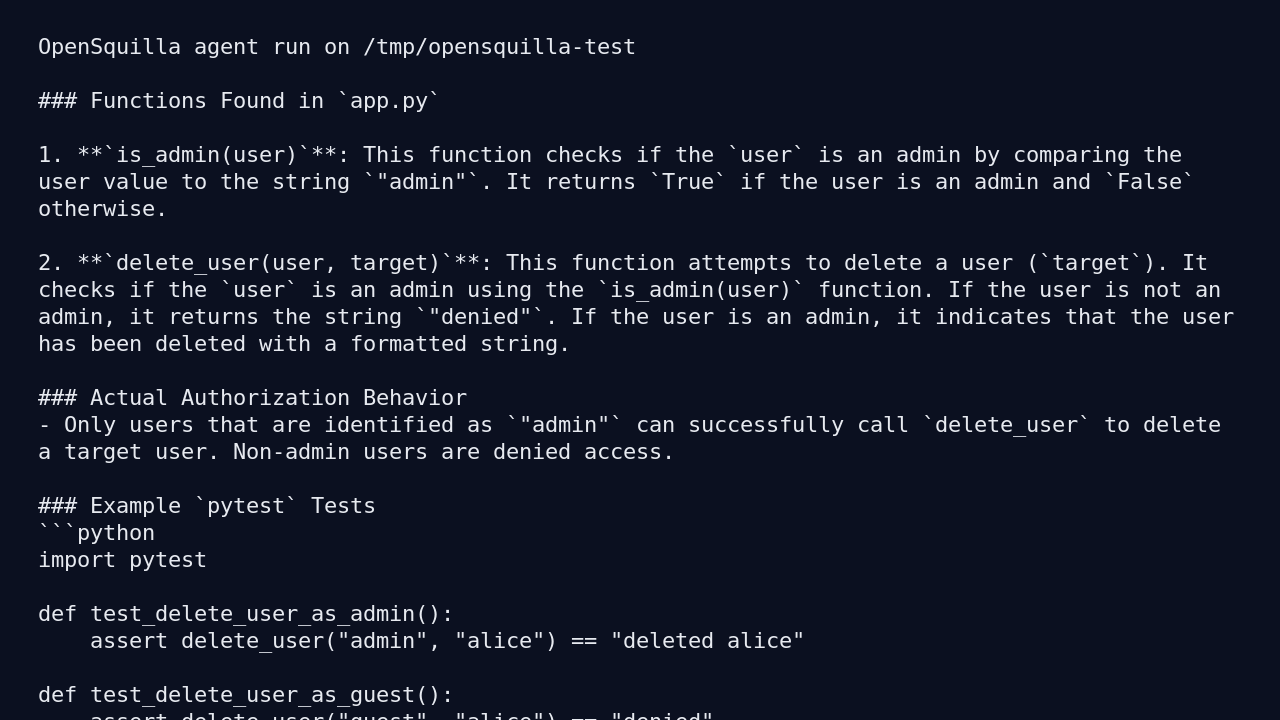
The JSONL transcript confirms that the agent called read_file on README.md and app.py. On the cost side, the run used around 24,503 tokens, with 2 requests and an estimated cost of about $0.002 through the proxy and openai/gpt-4o-mini.
OpenSquilla Web Interface
I also launched the local gateway:
opensquilla gateway run --port 18791
The interface responded with HTTP 200 on /control/. The page loads a JavaScript application with views for chat, sessions, configuration, setup, logs, health, channels, and usage. This is more than a simple CLI wrapper: you can tell the project is aiming for a full local cockpit.
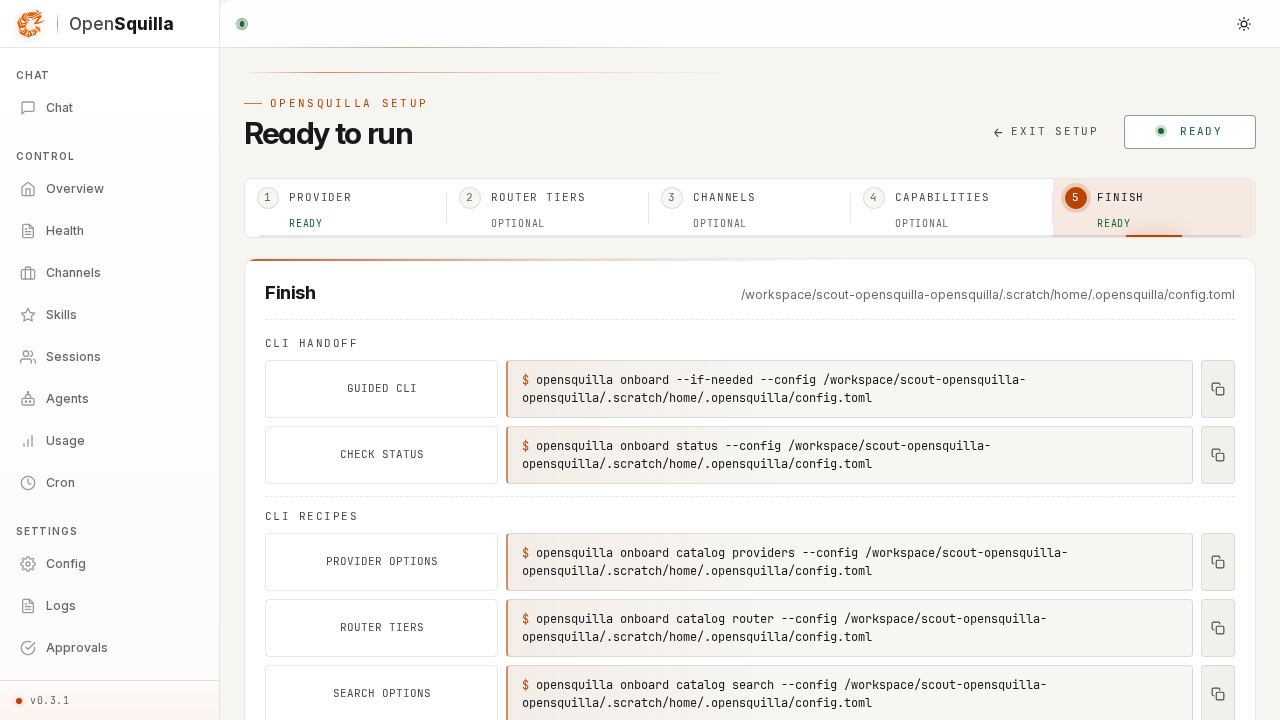
I did not leave the gateway running after the test. The Uvicorn server was stopped, and the temporary directories were cleaned up at the end.
What I Like About OpenSquilla
The first strong point is the product ambition. OpenSquilla is not just a script that calls a model. It already lays down the useful building blocks for a real local assistant: sessions, memory, tools, permissions, gateway, web interface, multiple providers.
I also like the provider compatibility. Being able to point to a custom OpenAI-compatible base is important when working with a proxy, OpenRouter, or an internal gateway.
Another positive: the traces are usable. Between the logs, the JSONL transcript, and the usage file, you can verify exactly what happened. For security or DevOps use cases, that auditability matters a lot.
The Limits of OpenSquilla
The most visible limit in my test is the weight of the recommended installation. The full profile depends on heavy ML packages. In a constrained environment, that can break before the first run even starts.
Second limit: the first agent result was not reliable enough. Without an explicit instruction to use file tools, the agent hallucinated tests for functions that did not exist. This is not entirely OpenSquilla’s fault since the model plays a big role, but the product should more strongly encourage tool grounding for code reviews.
Third limit: some internal messages are noisy. The logs are useful, but a general user can quickly get lost between sandbox, bootstrap, memory, model catalogs, and dependency warnings.
Does OpenSquilla Actually Work?
Yes, within the scope I tested. I installed the base source package, configured a real LLM provider via proxy, launched an agent against a small repo, observed file tool calls, got a useful response, and launched the local Web UI.
No, I cannot say the full promise is validated. I did not prove SquillaRouter under full conditions, nor the messaging channels, nor crons in production, nor long-term memory over several days. My test validates the core: a local agent driven by CLI and gateway, connected to a LLM, capable of reading a workspace and producing an analysis.
Should You Adopt OpenSquilla?
My verdict: try it, but do not blindly adopt it in production.
For a security freelancer, a DevOps engineer, or a developer who wants to build their own local assistant, OpenSquilla is clearly worth testing. It already brings a solid structure, with a real notion of runtime and cockpit.
For a team looking for a simple, stable tool to put in everyone’s hands, I would wait a bit longer. The project is promising, but it requires understanding providers, Python dependencies, permissions, memory, and installation paths.
The right use case today: personal lab, internal assistant prototype, technical monitoring, supervised automation. The wrong use case: replacing a CI workflow or a human operator tomorrow morning without proper guardrails.
FAQ
Can OpenSquilla be used without an OpenAI key?
Yes, if you have a compatible provider, a local proxy, or a supported local model. In my test, I used OpenRouter via a local OpenAI-compatible proxy.
Does OpenSquilla replace an agentic IDE?
Not directly. It looks more like a general-purpose agent runtime with CLI, Web UI, memory, and tools. For coding, it can help, but you need to strongly scope the permissions and instructions.
Is OpenSquilla production-ready?
I would classify it as a tool worth serious evaluation. The core works, but the full profile is heavy and some agent behaviors need to be monitored with transcripts, limits, and human validation.