


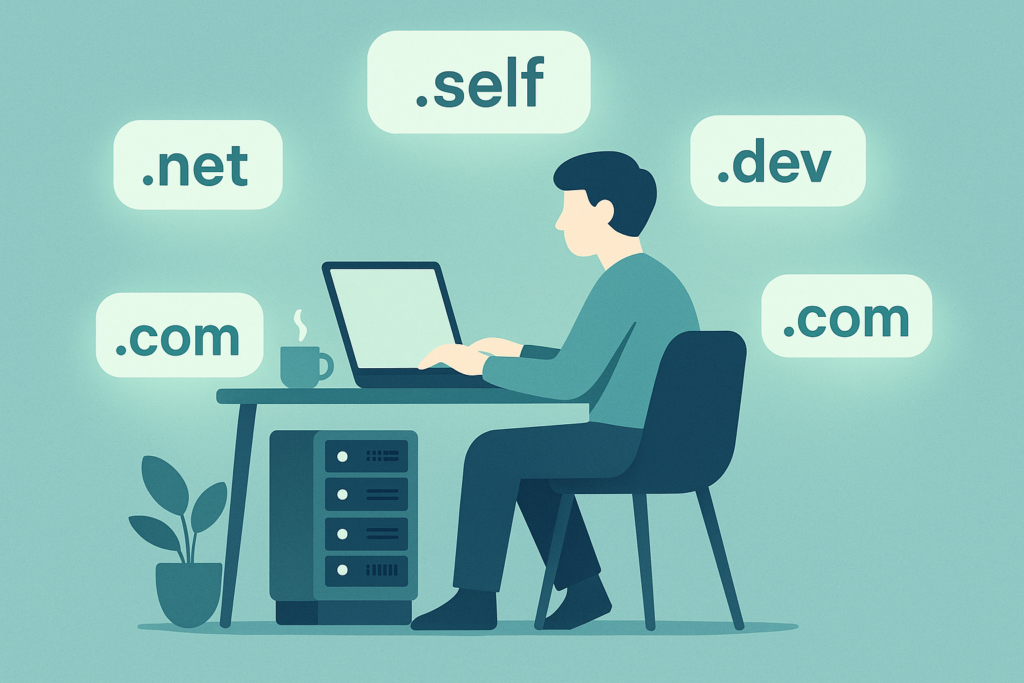
Self-hosting is gaining ground, but there’s still no dedicated infrastructure built around the privacy of people running their own services. That’s exactly the problem the Human-Centered Computing Foundation (HCCF) wants to solve with the .self project.
The .self TLD: what is it exactly?
The HCCF is an organization working to rethink web architecture around users rather than commercial interests. It has officially launched a campaign to obtain a new top-level domain (TLD) called .self, dedicated to ethical, human-centered technology.
The foundation is already an approved participant in the ICANN Applicant Support Program. So this isn’t just an idea floating around: an institutional process is underway, even if the ICANN evaluation hasn’t started yet and will take several years.
The core idea: give every person a unique domain under .self without revealing their real identity. Privacy is at the heart of the project. A model along the lines of alias.v.self would let anyone expose their self-hosted services without exposing their personal data.
Why this project is generating interest
Self-hosting is attracting more and more technically minded people who want to take back control of their data. But exposing a service on the internet requires a domain name, and getting a domain means declaring an identity and address in the WHOIS registration.
The .self TLD tries to address exactly that problem by offering:
- Anonymized domain assignment, with masked identity
- A “one person, one domain” model to prevent speculation
- A framework oriented toward self-hosted services, not commercial use
- Governance independent of the major domain registry players
It’s a proposal that lines up well with the values of the self-hosting community. But the practical questions are still wide open.
Questions nobody can answer yet
The Hacker News discussion, right after the brochure was published, quickly raised critical points. How do you verify that a domain actually belongs to one real person? Is self-hosting mandatory, and if so, how do you prove it? Who funds the project long-term?
The HCCF itself admits to being “in the very early stages.” The brochure circulating right now is a single-page PDF, which prompted some irony in the comments: an organization advocating for an ethical, human-centered web publishing in PDF rather than HTML is an easy target.
That point, while anecdotal, highlights a real risk: a project selling a vision without yet providing the technical details. DNS architecture, potential cryptography, handling name conflicts between people with the same alias, all of that still needs to be worked out.
There are already more than 530 internationally recognized generic TLDs. Creating a new one involves a long, expensive, and uncertain ICANN process. Alternatives like .me, DuckDNS, or existing free TLDs already cover part of the need.
A weak signal worth watching
Engagement on Hacker News and Reddit stayed modest, around 48 to 49 points in the early discussions at the end of June 2026. That’s a niche signal, not a groundswell. The technical community is curious but waiting for substance.
That said, the project’s positioning is relevant. The privacy pressure on self-hosters is real. The centralized model of domain registries raises legitimate questions. And ICANN did welcome the HCCF into its support program, which isn’t nothing.
If the foundation publishes serious technical documentation and a clear roadmap, the project deserves closer attention. Otherwise, it risks staying a great idea with no traction.
Key takeaways
- The
.selfTLD is driven by the Human-Centered Computing Foundation, an approved participant in the ICANN ASP - The goal is an anonymous, ethical domain reserved for self-hosting, on a “one person, one domain” basis
- The project is very preliminary: no public technical documentation, no precise timeline, and an ICANN process that will take years
- Practical questions (identity verification, funding, DNS resolution, handling duplicate aliases) remain unanswered publicly
- It’s a weak signal to keep an eye on, especially if solid official documentation and serious technical coverage emerge soon
If the intersection of internet governance, privacy, and self-hosting is your kind of thing, follow the blog or reach out directly. These are exactly the topics I keep a close watch on.